Keiko & keiko

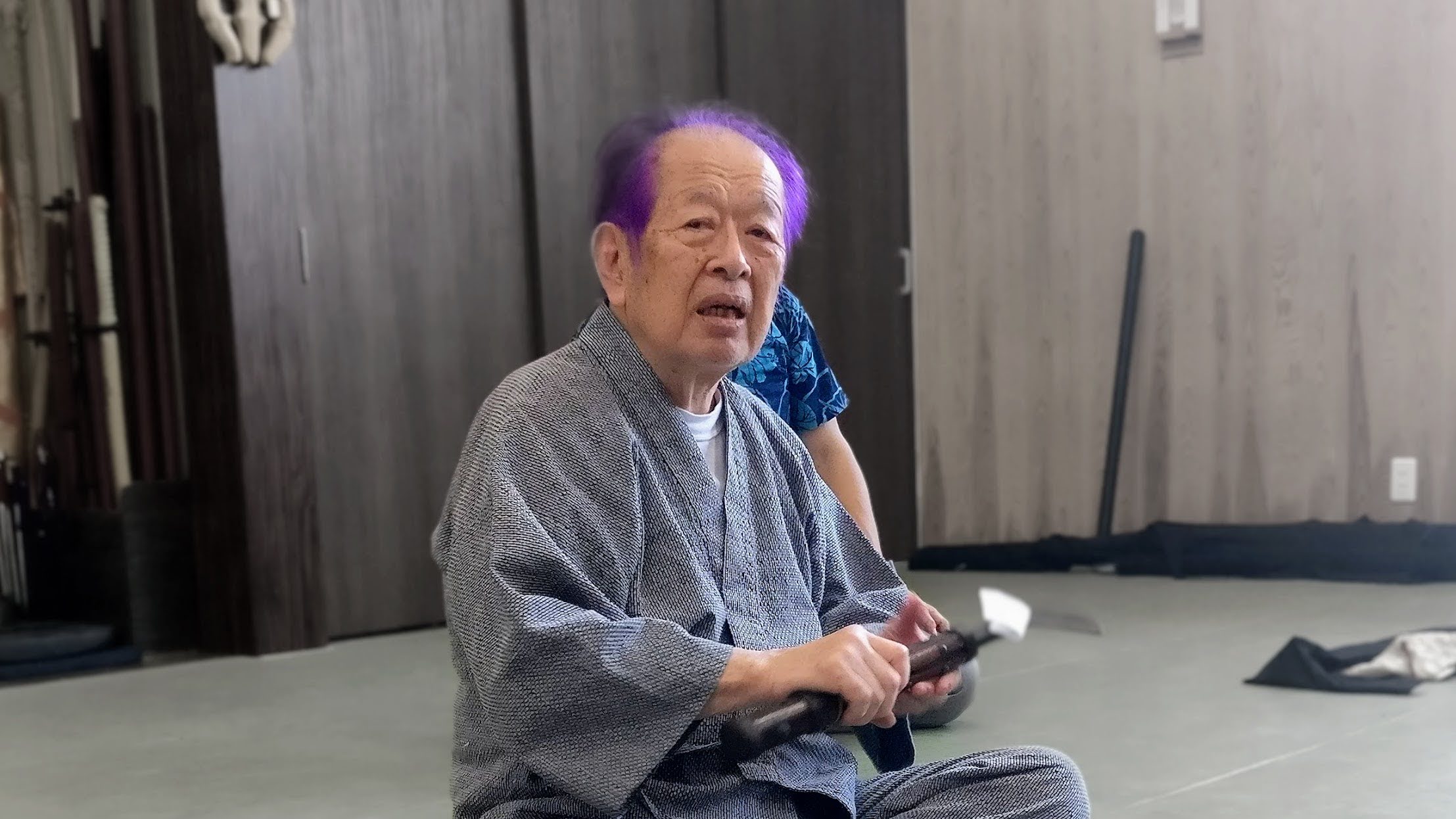
Sensei displaying the densho at dkms 3

Even though a few days have passed since the last day of the daikomyô sai the memory of this last day is still vivid in my mind.

Densho: The morning session was replaced by the exposition of many densho from the old time, sensei displaying in front of us invaluable makimono, techniques, and heihô concepts of many ancient fighting systems from the feudal times of Japanese warfare. Some of these scrolls had been rebuilt and consolidated and were 3 to 4 centuries old.

While displaying these treasures sensei insisted a lot on the value of these old documents and he explained that our budô was not a simple martial art (like a sport martial art) but that we should see it as a transmission (densho) of old warfare. As he said, even if you don’t understand or cannot read them, the simple fact of breathing the same air is already impacting our abilities to the better.

The techniques described in these scrolls have survived actual combat and have been transmitted by the ones who used them in fight. Unlike writers such as Nitobe who emphasized the values of the warrior, these densho are the living proof of their inner truth. They are not the romantic vision of an hypothetical fight but the result of their true efficiency. If these techniques had not proved their value in actual combat nobody would have survived war and therefore would not have been able to write them down on paper.

Sensei also added even though they had been the result of true fighting experience, they have been written down during peace times so they were written from memory by old men that didn’t fight for a long time. This is why we have to respect these forms but adapt them to the modern world and to today’s conditions of fight in order to ensure our survival.

As I often point remind the students: “remember that the best fighting manual will never fight for you except if you hold firmly with your hands and hit the opponent with it!”.

Personal training (keiko – 稽古 ) is more efficient when backed up by the knowledge of history (keiko – 経緯 懲 i.e. learn chronology by experience ). The solutions of today are to be found through our knowledge of the past. We should not do those techniques of yore exactly as they are described in the densho but use them as optional parameters or insight to take into account when in a real combat.

Therefore keiko (稽古) is deriving from keiko (経緯 懲)

After the brain training of the morning, we moved to body training in the afternoon. Through the various techniques and movements demonstrated by the jûgodan, sensei explained that genjutsu, the magic of art (幻術) was god given where ningenjutsu (人間術), human technology (human technique) is only man made. Art comes from the heart but technique comes from the brain and therefore is limited and not of such a high value.

This is something sensei has been repeating during the last week in his classes. Knowledge is easy to get in this media age but art is coming from within our Self. From this I understood that we should develop the kanjin kaname (eyes and mind of god) more than any type of intelectual knowledge. Back to the densho he repeated that even though we had to respect these historical truths, it was today and with our own abilities that would have to survive. Jû taijutsu deals with being flexible physically but also to give us the ability to survive any dangerous situation through our adaptability (jun nô ryoku).

A few days ago sensei was speaking of tenmon, chimon and gakumon, where gakumon was knowledge. And we explained that we had access to two types of knowledge. This is here the second knowledge (read the post) that we have to nurture and not the first one that is only biomechanical. Too many practitioners collect techniques instead of living them and develop only their biomechanical skills. Truth has many aspects and you will have to find yours in order to approriate these techniques for yourself as you are the one fighting.

“your ignorance alone creates the universe.
In reality One alone exists.
There is no person or god other than you” Ashtavakra Gita (15.16)

You train for yourself and your interpretations are as good as any other, but this can become a trap if you are sure to be right. Remember that “for who is holding a hammer, everything looks like a nail”.

On the technical side we continued to develop the gan shi nankotsu trilogy and sensei developed a new aspect to it. He used his thumb (shito ken) as he would a katana. He said that cutting through the opponent flesh was important. This shito gatana (指頭 刀) or yubi gatana (指刀) (he used both terms) is adding to the feeling of danger felt by uke.

At the dkms party sensei announced the theme for 2012 being “katana” and I think that this yubi gatana was already a hint on how we will use the sword next year. The sword techniques (densho) of kukishin ryû, togakure ryû, shinden fudô ryû being known (keiko), it is now time for us to free ourselves from these forms and to put our adaptive taijutsu into motion through the use of the sword and the mutô dori. Mutô dori is the highest level of weapon fighting and the proof of true mastership.

So please study (keiko – 稽古) and review your sword kata from the past and train them thoroughly (keiko –  経緯 懲) in order to be fully prepared when  Hatsumi sensei will be unveiling the shinken gata in a few weeks.

ps: On Sunday morning he confirmed the theme for 2012 as being “Ken” (all of them). He also precised that in 2013 we will be studying Yari and naginata. ;-)

Be happy and enjoy the christmas and new year time!

Posted in Thoughts on Budo | 1 Comment

Be Aware!

For the second day of dkms, it was raining so we had to retreat to a nearby building. Space was limited and sensei began his teaching by telling us to be aware of our environment. In a crowded area accidents might occur and like in a battlefield he asked us to add this element to the techniques we were doing today.

Warrior awareness was the theme and the introduction of today’s classes by sensei and he displayed many small weapons (kusari, nekote, and other shuriken) and asked us to be aware of these kinds of weapons, and to learn how to use them in order to know how to defend ourselves against them. Hidden weapons are very common in today’s street fights so we should develop our awareness in that respect.

To summarize this day of hard training (the floor was concrete), I would quote one sentence he repeated a few times during the training: “this is not about power, this is about control”.

Too often in martial arts, emphasis is put on physical power instead of the control (space, mind and body). Controlling the opponent means controlling his body and his brain (jin) and his environment: chi (floor), ten (weather or light conditions). Without controlling the outside, the above, or the behind of the attacker a winning action can bring defeat. This is why the bujinkan arts are more interested in controlling Uke than showing strength or force that are often mistaken for power.

On a ryôte dori type of technique sensei once again used the wave like movements of his shoulders and his body to control his attacker. This type of movement is done nearly without moving. By solely moving the shoulders up and down and turning around Uke at a very close distance uke is defeated. This shoulder movement would be effective in a very confined environment like a hole or on the battlefield.

Like he did yesterday he played again with the concept of kûkan no kyûsho. But Kû which is not only emptiness is encompassing all things within, and kû is the leading path to “zero”.

Sensei often speaks about becoming “zero”. This state can only be achieved once kû is understood and integrated in our body. He asked us to find the kûkan no naka no nagare (空間の中の流れ) because within this kûkan exists a flow that is kû and which is allowing us to transcend the form and to move naturally.

This is achieved by finding the kûkan no teko (空間の梃), the leverage or the various leverages (teko) to use to open Uke and to defeat him. By using these teko (familiar concept studied in the kukishin ryû), or their opposite known as “teko gyaku” (梃逆) we unveil all possibilities naturally and submit the opponent without using any strength. Our body if relaxed allows the natural movement to appear and to be used without any thinking process or any preconceived motion. I admit that I find it hard to put that into practice in my taijutsu but this is the goal to achieve.

He illustrated that by biting into the flesh of his opponent (hand, forearm, tit) and Tim’s reactions were quite self expressing.

From there we moved to some shime waza (締め技). A short reminder here, shimeru (shime) applies not only to the chokes but to any kind of constrictive action on the body. The basic hon jime and gyaku jime were demonstrated with the whole body (karada) and were sometimes completed by hits to the face or crushing actions to the throat and the body.

Sensei insisted also that we should use the whole body when applying those chokes, “karada no shime” he explained, while choking his opponent by moving around him. Footwork is the key element in the success of these movements. By moving the elgs you off balance Uke and cerate opeinings for the chokes or the hits.

What I understood today was that chokes are:
a) dynamic;
b) done with the whole body (and not only the arms);
c) can be completed by fists attacks.

Pain by sôke is a good teacher!

He was also changing his grip from one choking waza to another using pushing (oshi -押し) movements of the choking hand. Depending on the opening he was pushing or pressuring Uke’s upper body (not only the throat) with his pinky used as a blade to cut the flesh; with the heel of the palm to crush Uke’s Jûjiro or with the tip of the fingers to dig into the face or the neck. This ability to change the way to hold the opponent became obvious when he added a hidden knife and pulled it of his sleeve so that it was appearing like by magic in his hand. This metsubushi action (目潰し) was done while already applying the choke.

He warned us to learn these “bad guys” techniques in order to survive a real fight. The bujinkan, he said, is not teaching “bad guys” techniques but is teaching these things to be able to react correctly in a life threatening situation.

To avoid defeat, learn the ways of your enemy.

The way he was revealing the tantô hidden in his sleeve was very interesting. He was not pulling it out of the sleeve instead he was levelling his shoulder so that the weapon would pop out by itself. The karada was pulling the weapon not the hand. This is also how we should learn to draw the sword as in the nuki gata (drawing the sword) the blade is expelled from the scabbard by the body action not with the hand. This is quite different from regular and traditional sword practice.

Leaving the weapons we went back to unarmed combat and from the original ryôte dori technique we learnt how to use the pressure of the thumb and the pinky to dig into Uke’s skull, face, eyes, ears, etc. We did also a few nasty pinching techniques combined with striking hits to the chest.

In a limited space the “gan shi nankotsu” system finds here a logical application. Space being limited, the movements do not have the same momentum and pain is not coming from a distance but at very short range. Once again he insisted on finding the “kûkan no kyûsho” of the situation.

We did many techniques today around these principles and sensei said that this was a very important training for the jûgodan. No strength is used in these techniques, there is no power at all as Sôke is controlling Uke only with micro movements and mega pains. Pain without injury is the best way to calm down a dangerous situation.

On a side note, Sôke insisted that we should pay attention to avoid injuries and of the importance of being aware of our environment (reminder).

This apparently effortless full control he has at all time of his opponent(s) is always amazing to watch and to think that tomorrow he will be turning eighty is even more surprising. Sensei is not using any strength but he keeps full control of anyone attacking him.

This is why the bujinkan martial art is “not about power, (but) about control”.

Be aware and live happy!

Posted in Japan Trip | 3 Comments

Senpen Banka

dkms 2011 - during the first break

dkms 2011 - during the first break

Today was a fantastic Autumn day. The sun was shining, the 300 attendees full of joy to be together again for this very special bujinkan moment, and sensei was joyful and playful like a kid.

The whole was dedicated to the depth of the Kihon Happô and he asked many 15th dan to demonstrate their understanding of it. As an introduction he said that this day (and maybe the following ones) would be a “Jûgodan test”…

After speaking about some writings by Takeda Shingen (http://en.wikipedia.org/wiki/Takeda_Shingen) who said that men until 20 were working to be strong and then to understand weakness, he moved on to some very interesting concepts.

From this whole day of training I did my best to remember three things that he said and showed the depth of his budô.

“Gyokko Ryû is up and down, inside and outside”

Pedro trying to explain what he felt after being used as Uke by sensei, said that he had the feeling that sensei was up and down him, inside and outside his distance, to finally realized that he (Pedro) was alone as sensei was not even there (zero state). Sensei reminded us that this particular feeling of attacking the Ten and the Chi and the ura and the Omote was the main concepts of fighting of the Gyokko Ryû.
Distance being short the only way to use the body efficiently is to play with all these directions and deceive Uke on your real intentions. He added (as for everything this day) that no chikara (strength) was to be used and, as he said in our previous classes, that holding Uke without actually holding him was the key of true taijutsu.

As a joke he added that being 80 years old, he had no more physical strength and that his minimalist movements done with the whole karada (body) were creating the same effect as the use of the force. Age advancing physical strength is replaced by mental strength. Once again to way to control Uke it is not about using force but on the contrary to give him the feeling that you have disappeared.

“find the Kûkan no Kyûsho”

At some point he spoke extensively about finding the kûkan no kyûsho (空間の急所) or the weak point of the empty space in which the fight is happening.
In a movement, you should be able to understand where the Kyûsho is located, to avoid it and to throw Uke into it. He said that this was the real mastery of budô and that not so many martial artists couls even understand that.

In whatever situation you encounter in life lies a kyûsho somewhere. Being able to discover this kyûsho and to use it to our own benefit is the key to happiness and safety.

“senpen banka”

But the most amazing thing that sensei told us today concerned the concept of “senpen banka”.
Senpen banka is another “Hatsumism” composed of three different concepts reshuffled together to create something new.

“sen” is 千 thousand
“man” (here “ban”) is 万 10000
“ben + ka” is in fact 変化 henka cut in two halves (hen and ka are separated)..

Senpen then is “1000 changes” and “banka” is 10000 changes. note that both hen and ka mean “change”.

The concept of senpen banka is quite similar to the concept of “banpen fûgyô” (10000 changes no surprise) from the Gyokko Ryû but stronger. Sensei said that we should move in a relax manner with no preconceived ideas on what to expect or what to do, in order to be able to find the kûkan no kyûsho hidden in the situation.

Also if we think a little further it can also mean that whether there are 1000 changes or 10000 changes our attitude should not be modified. Losing or winning is not the point (he reminded it to us in a recent class saying that this win/lose vision of the world was childish). By keeping the proper attitude in life one could overcome any difficulties (here the changes) that he might find on his way and lead a happy life.

Once again it was for me the proof, if need to be, that the bujinkan is much more than a simple bio mechanical martial art but a real school of wisdom from which one can grow the true warrior spirit and become a true bujin.

Thank you sensei for this fantastic Autumn day on the inner secrets of the kihon happô.

Posted in Japan Trip, Thoughts on Budo | 7 Comments

Use a Telescope to see through Space and Time

On Sunday I did a technique at the opening of the class that sensei used to teach us the shizen karada – the natural body movement.

Karada – body ( 自然 体) is a often used by sensei during his classes as everything we do is based on a body or “non body” movement.
On a ryôte dori ( 両手取 り) slide your arms inside Uke’s arms and take his balance. When sensei did it to me I felt nothing he just vanished (melted?) in my grab in such a natural way that I had the feeling that my grip was returned against me.
There was so much softness in his counter action that there was no way for me to counter it or to think on how to react to it.
This feeling is quite strange and happens every time you have the chance to be his Uke. There is power within softness.

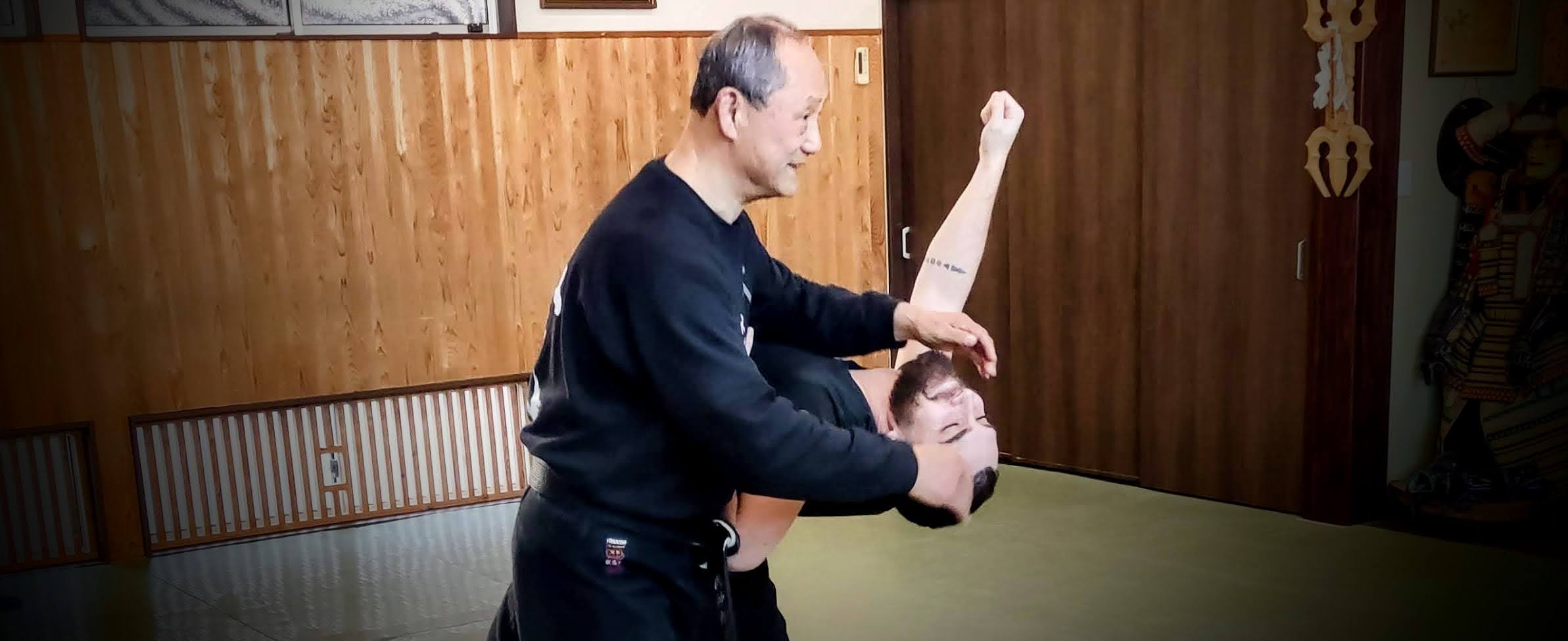
To achieve that Hatsumi sensei was simply joining his shoulders between my arms as if he had no bone structure, no rib cage in the middle! By moving the shoulders in a wave action back and forth he slide himself in between my grip and took my balance. The naturalness of his body movement was amazing as nothing could be done to avoid it. Using the karada (体) without chikara – force, strength (力), he then used the gan shi nankotsu (眼指軟骨) to inflict excruciating pain to my eyes and mouth, forcing me to bend backward and therefore to lose my balance.
I can understand it what he did to me but I wasn’t able to reproduce it. As always it is one thing to understand and another one to be able to do it.

When sensei was in between my arms I felt I was facing a wall advancing towards me and I couldn’t avoid it as I was stupidly still grabbing his lapels. Funnily I know I could have let it go but I didn’t. He was controlling my body and my brain together. The only thing I could do was watching my demise. Using the whole body is not moving the body it is being one with your body and Uke’s body at the same time so no free space is available for you to escape.

If I try to describe the feeling a little more it is like there is no strength at all opposing yours and then nothing to fight against. The simple shoulder wave movement together with a body that has been polished for tens of years is what is doing it. Once again, your rank doesn’t prevent you from training and you have to train for a very long time in order to get this ease in action that comes from pure consciousness.

Later during the class sensei used the image of the circle and of pi. Actually when continuing the movement your footwork should be in accordance together with uke’s movement of attack so that you pivot in a circle inside Uke’s attack at a 180° angle to go with him where his body is leading him. By doing so, Uke is not aware of where you are and loses his balance because nothing is opposing him. This pi application has been developed in many other martial arts like Aikidô for example but here in our case there is no grabbing of Uke. Sensei merely used the space created by this dynamic and natural body positioning to stick to Uke so close that he is invisible to Uke’s awareness. Sensei’s body moves like in cloud. It is at the same time a mienai waza, a kûkan and a nagare with nothing to stop Uke’s body but diabling him to perceive you. As they say in the Takagi Yôshin Ryû and the Kukishin Ryû: “ahead lies paradise”. As nothing prevents Uke’s movements Uke falls by only fighting his own strength.

To summarize the whole training that day sensei used a nice image. He said: “don’t be strong, don’t be weak, be zero and through this zero you can see the solution”. Saying that he put his hands in a circle and looked through them as if using a telescope.

Once again everything is linked. telescopes are used to see through sideral space and the stronger they are, the further back in time they can see. You should become a powerful telescope and see through time and space in order to be aware of what is coming next even before Uke knows about it.

Then gan shi nankotsu of this year (眼指軟骨) turns into gan shi nankotsu (眼 其 軟 骨) where shi (其) is oneself; nan (軟) is soft; kotsu (骨) is knack, skill, secret. The “eye, finger, cartilage” is now through our telescope a means to see through yourself, the secret of softness that will defeat the opponent.

Posted in General thoughts, Japan Trip | 2 Comments

A Needle will not Blow a Balloon

In any Japan trip the first classes with sensei give some insight on what is going to be taught next. My first classes last days were fantastic, full of insights … and full of pain!

About 80 students are attending the classes (and more are arriving every day) and I have the feeling that the dkms 2011 will be a hispanic one as many friends from Spain and South America are there: Alex, Christian, Nestor, Rafael, Marcello, Jose and many others.

I must say that sensei is in a very good mood and shape and that his minimalist taijutsu is getting more and more impressive.

I had the honor to open the classes and once again he went into the “gan shi nankotsu” concept that he has been unveiling since last summer. I already wrote about this “add-on” t to the kihon happô theme and concept on my Facebook notes, check it if you didn’t read it it is called “ken tai ichi jo”.

As I said the class was full of insights, I will try to explain three things that Hatsumi sensei explained during the class:

A needle will not blow a balloon  i.e. Kosshi and Koppô are complementary:
This was really mind blowing! Westerners have a tendency to split everything in closed boxes were in fact reality is based on a more higher understanding of these concepts. Even though Kosshi and Koppô are different they mix nicely together to create a flow that is like a third reality. From now we should see these two concepts as the “plus” and “minus” of some magnetic field.

Hatsumi sensei explained that our fingers controlling Uke softly were actually the Kosshi jutsu and that our bone structure, our squeleton moving freely around this point of control would allow us to deal “softly” with the opponent’s intentions. He said,that,when this Kosshi/Koppô mix is mastered, you are able to deal with any opponent whatever his body shape. This is when he used this image: “when you master this you can push a needle so softly into a balloon that eventually itwill not blow up”. This controlling action of the whole body is so soft that no force at all is used in the process.
Intellectually easy to get, but I still don’t know howto do it.

Time is now  i.e. create time when you are in a hurry:

In each class sensei insists a lot on being able to create time within time. If you have been training long enough you already have experienced this feeling. Uke attacks full speed and you have the impression that he is moving in slow motion.
What sensei explained was about the same except that the use of the little pains generated by the “gan shi nankotsu” movements prevent Uke of carrying out his attacks at the normal speed. This hindering of his intentions delays his actions and therefore creates time that you can use to control, hit, or destroy him.
Since Einstein we know that time is relative and when our actions are forcing uke to think and to adjust his intentions in order to survive then we force him to “slow down” his efficiency. In a way this is E=MC² where E = extermination; M = mind, C = control. Then we can write that the Extermination of Uke equals Mind Control to the square!

Tenmon (天 門), Chimon (地 門 ),Gakumon (学 門):

But the main point made by sensei was when he spoke about the trilogy of Tenmon, Chimon and Gakumon. As far as I understood, We can see the martial art as a mix of biomechanical techniques – Chimon (waza) and of higher understanding – Tenmon (kûden – nearly spiritual). These two aspects are completed by another one Gakumon or knowledge. Hatsumi sensei said that many martial arts are stuck at the Chimon level and that others are focusing more on the spiritual level. The Bujinkan is including the Gakumon from the real beginning and the three become one.
How is it possible? It is simple if you think that two levels of Gakumon are there. The first Gakumon is basic knowledge allowing you to link the first two aspects of Chimon and Tenmon.
The second one, taught in the bujinkan by sensei is beyond forms and words and can nly be reached when your taijutsu has been polished for more many many years.
When the three are mastered a new dimension you reach is that of pure consciousness – shiki ( 識).
Thereforeand if my interpretation is correct we understand sensei’s last comment at the end of the class: “I teach you the three together because they are one, and this is the bujinkan and the higher form of martial art”.

Be Happy!

Posted in Japan Trip, Thoughts on Budo | 2 Comments

Freedom & Happiness

This is Daikomyo sai time again and I cherish this moment of the year more than any moment.

I arrived yesterday afternoon for another Daikomyo sai in Japan. After a fex hours I alrready met with Hugues, Cédric, Philippe, Indrek, Peter and Sheila. It is always a very nice moment and brings me a lot of happiness.

Being happy is what Hatsumi Sensei has been teaching us since the beginning but many bujinkan followers don’t get it and it is sad. Freedom and happiness is the core teaching of the bujinkan. As Epictetus said “those who are looking for power and money will fail, the only objective of human beings is to find freedom and to be happy”.

Everything in Life is changing, as it is said in the I ching, change is the only permanent thing on earth. But why is it that we are always looking for permanence when change is everywhere? Bujinkan followers often get lost on their search for power and money. Instead of focusing on the things we can influence, we often force things that are not in our power to serve our own selfish interests. By doing so we lose our freedom and become unhappy.

Epitectus said: “What bothers humans is not reality but the judgments we make on reality”. Then stop judging others try simply to be happy with them. We have to train only for ourself with no expectations and then freedom will be achieved and we will find happiness. Each time we replace personal actions by selfish desires we get lost. Our desires, our attachment (power, money) are enslaving us. Be what you are and stop trying to be someone you are not. Everything is created in our brain. This is not reality this is an illusion.

An Indian sage called Ashtavakra wrote:

It is true what they say:“You are what you think.” If you think you are bound you are bound. If you think you are free you are free.

Choose to be free and Happy. Being happy is a personal choice and nothing can give it to you if you don’t make this choice.

I really think that Hatsumi Sensei is a philosopher more than a martial art teacher. His martial art classes are only an excuse and a tool to help us get the proper attitude in Life that will make us happy.

This year of kihon happô was dedicated to the start of a new cycle. Decide now to be what you are, choose to be happy, walk the path of freedom.

So enjoy these magic days of Daikomyo sai and start anew in this new cycle by taking the good decisions and being open minded.

“You are pure Consciousness— the substance of the universe.
The universe exists within you. Don’t be small-minded” Ashtavakra

Be Happy!

Posted in Japan Trip, Thoughts on Budo | 9 Comments

Tenchijin University 2011

Reminder: Tenchijin University in PAris from October 15th to 19th (late). We will cover all the techniques and fundamentals of the Tenchijin Ryaku no Maki established by Hatsumi Sensei as the prerequisite for the study of the bujinkan martial arts back in 1983.

We will work on the revised structure by sensei from 1987.

Classes will bein French and English and 9 manuals will be given to follow the classes and to take notes.

Trainings will be partly indoor and partly outdoor

Lunches (sandwich) are provided as well as free lodging at night in the dôjô.

If you are interested please visit the website: http://tenchijinuniversity.wordpress.com/

Posted in Thoughts on Budo | 1 Comment

YSTT Update Jun 2011

In exactly 30 days the Yûro Shi Tenno Taikai of Paris begins!

This year has passed so fast that I am amazed that this is already the time for this major seminar. The Paris Taikai has evolved a lot since its creation back in 2007.

This is a very special seminar that was designed to give a chance to get the « Taikai feeling » of the old days to the newcomers to the bujinkan and a sense of « the good ol’days » to the old bujinkan members.

This seminar is special for many reasons:

First, this is the only remaining seminar where the « Shi tenno » are teaching together. Since 1993 Sven, Peter, Pedro & Arnaud have been teaching together in Spain, France, England, Ireland etc…

Second, the four friends are used to teach together which gives a kind of « family feeling » to this event;

Third, this is a 3 days seminar like the taikai of the past when Hatsumi sensei was travelling the world to spread his teaching;

Fourth, the group of participants is divided into four groups by technical level. This means that a beginner will receive a class that he or she can understand; but also that a high rank student (judan and above) will also get something to improve his or her understanding;

Fifth, each day is divided into small training sessions of about 1 hour where each group has the chance to train with each one of the shihan in a private class;

Sixth, the 3 training halls (mats or wooden floor) allow each one to spend a full day of training in different environment;

Seventh, the free t-shirt, the hot meals, the free lodging (during, before or after the event), makes it a big opportunity to exchange with the many practitioners from all Europe but also to take the chance to visit Paris;

Eighth, the final party at the end of the third day is always a good moment before going back home and parting from 150 new friends coming from 15 to 18 countries.

The YSTT is a very good opportunity to meet your buyu from Europe, to exchange, train, and learn a lot of things in a very friendly environment.

This year, this is the 27th year of my bujinkan training. SO I decided that each participant that is booked online will receive a FREE 2 months unlimited access to our online streaming website displaying more than 600 bujinkan techniques.

Thank you for your support!

A. Cousergue
Bujinkan Shihan

REGISTER HERE

Posted in seminar | Leave a comment

YSTT 2011

Calligraphies by Hatsumi Sensei for the "Yûro shi tennô"

Please check the new page on the Paris Taikai on this site

HERE

Posted in seminar | 1 Comment

Japan Update: Denki & Tenki

Today was a nice day, the weather was nice, not too hot and not too cold, and I learnt many new things. The reason why we come to train in Japan is to better our knowledge about proper movements and today was full of insights at all levels.

Erick "Mr Denki"

I spoke with two Swedish friends, Petter Swedin who is living and studying in Sapporo (Hokkaido) and his friend Erick who is studying electricity engineering here in Japan, and they explained the reasons why the Japanese have had some issues with their power grid after the tsunami. When in the 19th century electricity was first introduced to Japan it was through the Europeans. The Europeans are using a 220v/50 herz technology. When the Tokyo power grid has been rebuilt after the war by the Americans, they used a 110v/60 herz technology. So until this day Japan has been using two different power grids that are not easily compatible together.

Petter getting everyday more Japanese

After the Tsunami transferring power from one part of Japan to another proved to be difficult and with so many electricity production unit down it took them some time to be able to supply electricity to the whole country. This is a lesson from History.

Petter and Erick please feel free to add your comments if you need to add or precise anything.

I found it really interesting and my guess that in a near future when the Japanese will have recovered from this major disaster, they will find ways to unify their power grids so that it never happens again. Our actions are dictated by our evolution and past actions create the conditions of the present, and of our future survival. This is a true budô lesson.

Playing with the Japanese sounds, denki (電気), “electricity” can also be written as denki (伝記 ), “life story” but could also be denki (伝気), “transmission of energy” or tenki (天気), “energy of heaven” (weather). Therefore through the story of our training life we evolve from electrical power into the transmission of the energy of heaven. In other words we grow from chi no sekai (地 の世界), in the material world, to the ten no sekai (天の世界) in the spiritual world, through the connection of the jin no sekai (神 の世界) in the divine world! The link between heaven, earth and man is the step stone of the bujinkan tenchijin and forgetting it can prove to be painful and a big mistake.

no comment...

During our fist class of the day with Noguchi sensei we covered a big part of the jin ryaku no maki from the tenchijin. We studied many things but this class was for me like a real sanshin. First and in relation with what I just wrote, I finally understood gokuraku otoshi (極楽落し, falling from heaven). In this particular technique, the movement is applied onto the arm (ten) and finished by sliding uke’s leg to make him fall to the ground with jigoku otoshi. Actually you trap the jin by playing the ten (arm) and the chi (leg). That was an eye opener for me. I have been training bujinkan for over 27 years and I trained this technique many times but only now I became aware of its signification. As Hatsumi sensei wrote in “Unarmed fighting techniques of the samurai” on the introduction of the first level of the Gyokko ryû: “it is important to know the meaning of the names of the techniques”.

My second discovery was something Noguchi said during another technique. He said: “here you can do three things: oshi, otoshi, nage”. We are all aware of the differences between otoshi (落す otosu to make someone swoon) and nage ( 投げる nageru) but it was the first time I heard of oshi (押す osu to push). As this is often the case with what we learn here in Japan, it sounds so logical that “pushing” uke could be part of the technique that you always feel stupid not to have known about it in the first place. And again, this is why you have to come and train in Japan with Sôke and the shihan because each class will bring new insights on what you are supposed to know.

The last part of my sanshin for today happened when doing yume makura (夢枕) and for the first time in my many years of training I understood the difference between yume makura and te makura (even though I thought I knew it). Makura is the modern Japanese name for pillow (also to lead in), but as it is often the case with the evolution of languages the original meaning meant “support” so the “hand pillow” used to be a “supporting hand” pushing up onto the elbow joint. In yume (dream) makura, you are now supporting your dreams like the buddha lying down onto the ground and supporting his head.

In fact the whole secret is to use yori modoshi (寄り, to give up, and 戻し, returning or giving back) to transform the seoi nage into a te makura to bring uke down to the ground. The body action looks like a “8” loop moving forward with the seoi nage, pushing uke backwards in the direction of his tension, extending his arm and going down with him to the ground. The idea is to push/pull uke and togo up/down to bring him with you to the ground.

Noguchi sensei was brilliant as usual and I learned many details that will improve my whole taijutsu. Unfortunately, the class ended well before we covered the whole jin ryaku no maki. But those being in Atago next Friday afternoon will have the chance to study the remaining movements with Noguchi sensei.

The class with Sôke was also an eye opener (physically and mentally). Many students were there and many newcomers too. My friend Gillian freshly arriving from Australia was there too and I am always happy to see her. Whenever she is in Europe to visit her relatives, she hops by to my dôjô in Paris and train with us, and it is always a pleasure.

Thomas Franzen

Thomas Franzen from Sweden was asked to demonstrate a few techniques in his dynamic and efficient taijutsu and Sôke used them as a start for his painful techniques. He insisted again on the permanent use of the fingers to inflict pain on uke’s fingers or his face and that it was in the theme of this year. At one point he showed how to use the fingers on the face and how to inflict excruciating pain on a few kyûsho at hiryuran and jinchû at the same time. My partner for the class asked sensei to demonstrate the technique to him and he came back bleeding I am sure he will remember it for sure. The best way to learn is to ask Sôke to do it on you then pain becomes your teacher. Speaking of pain, Nakadai sensei, Shiraishi sensei and Yabunaka sensei were used many times and you could “hear” the pain. I now know that not only gaijin can scream, pain is universal! He also said something about kyûsho (急所) that Steve did a nice job translating sôke’s words for the whole but here he had a hard time getting it. Steve even said to his partner: “sensei knows I cannot translate that, so I guess this is part of my training”. The idea was that you don’t go for the kyûsho straight but only for the area around it, uke’s reactions will create the conditions of pain. Sensei often teaches at multiple levels and getting you off balance by forcing you to do things you are unable to do is part of his way of teaching.

Another thing that sensei said during the class is that you can outmaneuver your opponent by making him think that you do not know what you are doing. If uke thinks that you are a bad fighter, he will get a false sense of superiority speed up his downfall. After all deception is ninjutsu and inyo is everywhere!

Erick and Michael after training

Sensei was in a very good state of mind and we also did many sannin dori techniques, he said that movements do not need to look good, on the contrary and that sannin dori is the best way to develop actual fighting skills. And that you cannot find that kind of training in gendai budô, only in bujinkan.

After a very short break (there was no calligraphy session) sensei asked me to demonstrate a technique. It was some kind of tenchi inyo movement with seoi nage/harai goshi type of throw at the end. Sensei asked to demonstrate it a few times slower and slower and we played with this until the end of the class. Sensei added many painful finger grabs and multiple soft hits to disorient uke. When you receive multiple speedy slaps on the face and the body, your brain becomes unable to deal with all these information. There is no real pain only a flow of little pains as if you were fighting a bee hive or a poisonous jellyfish.

We also did some daisho sabaki movements with nearly each technique, learning how to use our sword or uke’s sword still in the belt and crushing uke’s fingers at the same time. Sensei said that this was real fighting skills and that it was quite far from the modern ways of sword fighting taught in the “traditional schools” in Japan. Finally we ended with a simple mutô dori technique where you go forward on the jodan kiri. Moving forward he said is the best way to avoid the cut as uke will avoid you. In real fight you create opportunities by not playing the game according to uke’s perceptions. If you try to dodge the cut you get cut but if you walk calmly towards uke then you can control his space and get a hold on his forward hand (and crush his fingers on the tsuka). A nice class full of pain and discoveries.

The sakki test session was strange as none of the four applicants could get it. They had only one chance. After the last one failed sensei decided to stop the sakki test, they will all have two more chances on Sunday. This was also a lesson as Sensei could feel that the conditions were not good last night so he adapted to the flow and canceled the second chance. The “givers” and the “takers” are not to be criticized, the moment was not correct and Sensei took the right decision. Knowing when it is time and when it is not time to do something is also part of our training. Ninjutsu is about awareness and developing the ability to seize a situation should be an important part of our training.

Sesnei leaving the dôjô with Someya sensei

At the beginning of the class, Anthony Netztler from New Zealand received the gold medal of the Bujinkan for his long training and achievement. We had a nice talk in the train going back to Kashiwa. Anthony has been living many years here in Japan and is one of the pillars of the bujinkan and he deserved this reward. In the past Sensei would give the gold medal mainly to the visitors and not to the residents I guess this is why Anthony didn’t get it a long time ago. Thank you Anthony for your presence.

How to get there?

While writing this article I met a Japanese woman Kazue san who spoke very good English and whose kids are training bujinkan with Duncan Stewart.

We had a very nice discussion about Japan, the tsunami, Fukushima and the way things are understood from the other end of the world.

Tsukasa Yakitori restaurant address

Her father has a yakitori restaurant called tsukasa (つかさ) in the same street as the Kashiwa Plaza Annex Hotel with a “ninja menu” in English (see map). I invite you all to eat there during your next stay in Kashiwa.

(modified end – a few hours later) After this post was sent, I got two messages from Duncan and Kazue san telling me that I got it wrong.

So somebody else from America wrote the English menu not Duncan. My mistake. But you can still complain to him if you are unsatisfied … if you dare to do it. :)

Be happy!

ps: thank you Ilona for your note ;)
Posted in Japan Trip, Thoughts on Budo | 8 Comments